What is a Health Maintenance Organization Plan?
What is a Health Maintenance Organization Plan?
At a Glance: A Health Maintenance Organization (HMO) plan is a type of health insurance that covers care through a specific network of doctors, hospitals, and providers. In exchange for lower premiums and predictable out-of-pocket costs, members choose a primary care physician who coordinates their care and provides referrals to see specialists. Coverage is generally limited to in-network providers except in emergencies. HMOs are a strong fit for organizations who value coordinated care and don't mind trading some provider flexibility for lower costs.
When comparing health insurance options, you will likely encounter the term HMO. A Health Maintenance Organization plan (HMO) is a type of managed care health insurance plan that provides coverage through a specific network of doctors, hospitals, and health care providers. HMO plans typically offer lower premiums and out-of-pocket costs in exchange for less flexibility in choosing providers. Understanding how HMO plans work, including the role of primary care physicians, referral requirements, and network restrictions, is important before enrolling in this type of coverage.
What Is a Health Maintenance Organization (HMO)?
All covered care must come from in-network providers. The HMO network includes doctors, specialists, hospitals, labs, and pharmacies that have contracted with the insurance company. Out-of-network care is generally not covered except in emergencies.
A Health Maintenance Organization is a type of managed care health insurance plan that provides coverage through a contracted network of health professionals. Members are required to choose a primary care provider who coordinates their care, and the plan emphasizes preventive care and coordinated treatment. HMOs are one of the most common health plans in the United States.
HMOs, which were developed as an alternative to traditional fee-for-service insurance, are designed to control healthcare costs through managed care. They gained popularity after the
HMO Act of 1973 and are now offered by most major health insurance companies. The key characteristics of an HMO include care coordinated through a primary care physician, referrals required to see specialists, coverage limited to in-network providers, lower premiums and predictable costs, and a focus on preventive care and wellness.
How Does an HMO Plan Work?
When you enroll in an HMO plan, you must choose a primary care physician from the HMO's network. Your PCP serves as your main point of contact for healthcare needs, and options typically include family medicine, internal medicine, or pediatric physicians. Most plans allow you to change your PCP if you are not satisfied, though you should check your specific plan rules for the process.
Physician Services
Your primary care physician plays a central role in your healthcare. They provide routine checkups and preventive care, diagnose and treat common illnesses and conditions, manage chronic conditions and ongoing health needs, coordinate all care and maintain your health records, and issue referrals to specialists when needed. This coordinated approach helps ensure all your providers are aware of your complete health picture.
Referral Requirements
One of the defining features of HMO plans is the referral requirement for specialist care. You must obtain a referral from your PCP before seeing a specialist, as your PCP evaluates the need and determines the appropriate specialist. The referral authorizes the HMO to cover the visit, and without it, the HMO typically will not pay for specialist care. Some exceptions may apply for certain services like OB/GYN visits, mental health services, and emergencies.
What Does an HMO Plan Cover?
HMO plans provide comprehensive coverage for a wide range of healthcare services. Preventive care is a cornerstone of HMO coverage and includes annual wellness exams, immunizations and vaccinations, and routine screenings such as mammograms, colonoscopies, and blood tests. Preventive services are often covered at 100% with no cost-sharing required from the member.
Medical Care
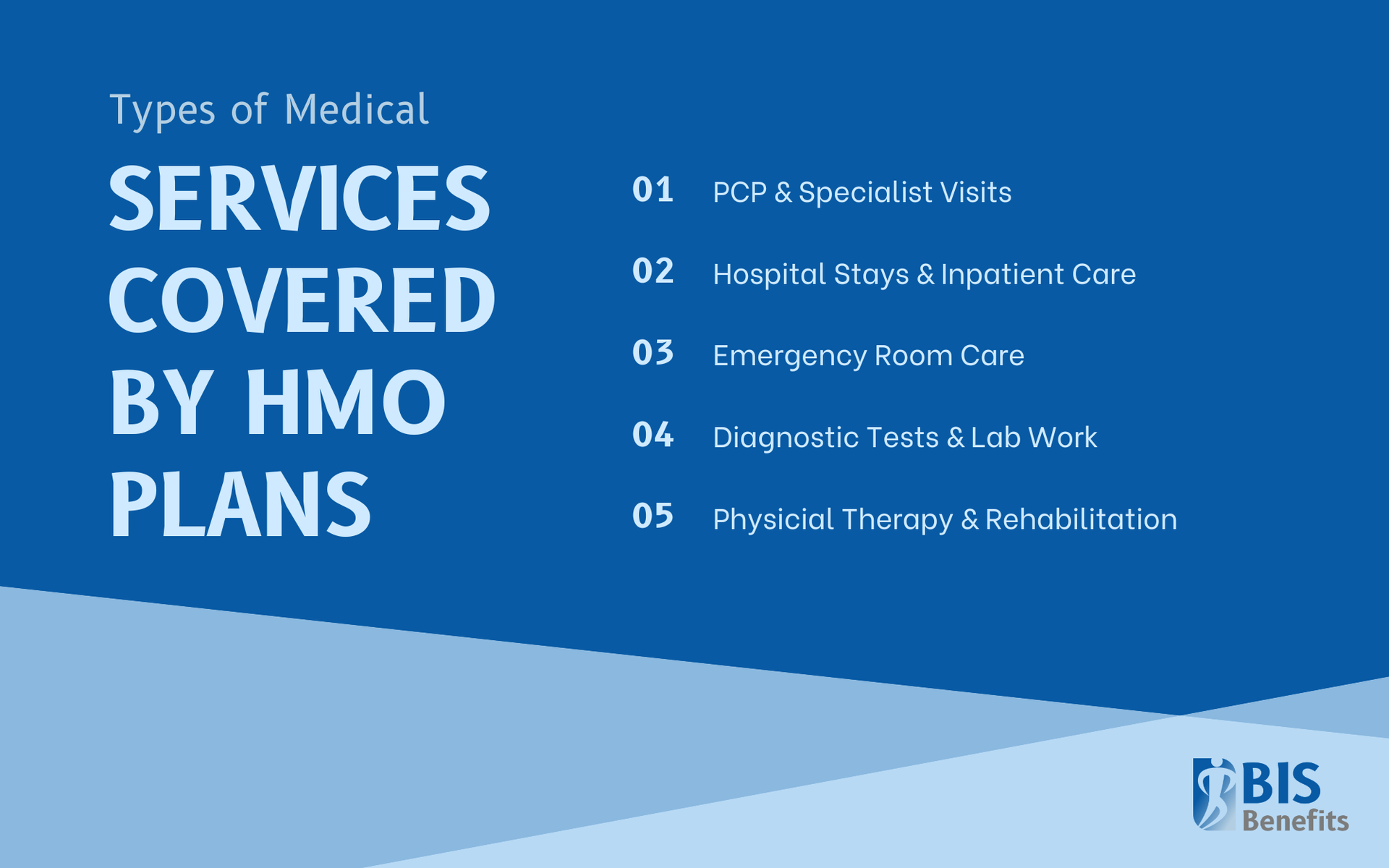
Medical services covered by HMO plans include:
- Doctor visits and specialist consultations
- Hospital stays and inpatient care
- Emergency room and urgent care, surgical procedures
- Diagnostic tests and lab work
- Physical therapy and rehabilitation
Prescriptions
Prescription drug coverage is also included, with a formulary of covered medications organized into tiers such as generic, preferred brand, and non-preferred brand. Members may be required to use network pharmacies, and prior authorization may be needed for certain medications.
Mental Health & Behavioral Services
Counseling, therapy, psychiatric services, and treatment for substance abuse are typically covered. Some plans allow direct access to mental health providers without a PCP referral.
Additional Benefits
Vision and dental coverage may be limited or require separate coverage depending on the plan.
Other benefits may include:
- Maternity and newborn care
- Pediatric services
- Wellness programs
- Health resources

HMO Costs and Savings
HMO plans typically have lower monthly premiums than Preferred Provider Organization (PPO) plans and other coverage types. These savings come from the managed care approach and network restrictions, making HMOs a good option for budget-conscious individuals and families. Beyond lower premiums, HMO plans offer predictable out-of-pocket costs through fixed copays paid at the time of service, deductibles that are often lower than other plan types or sometimes $0, coinsurance that may apply to certain services after the deductible, and an out-of-pocket maximum that caps total annual spending.
HMOs cost less because of negotiated rates with network providers, managed care that reduces unnecessary services, a referral system that controls specialist utilization, a preventive care focus that reduces expensive treatments, and no out-of-network claims to process. When evaluating costs, consider the trade-off between lower premiums and less flexibility.
Advantages of HMO Plans
Lower Cost Structure
The primary advantage of HMO plans is their lower cost structure. Members benefit from lower monthly premiums than most other plan types, reduced deductibles and copays, predictable out-of-pocket expenses, and no balance billing from network providers. These cost savings make healthcare more accessible and budget-friendly.
Coordinated Care
Your PCP manages all aspects of your healthcare, which leads to better communication between providers, reduces duplicate tests and conflicting treatments, and provides a comprehensive view of your health history. This coordination can result in better health outcomes and fewer gaps in care.
Preventive Care
Under HMO plans, preventive services are often covered at no cost to encourage annual checkups and screenings. This focus on early detection of health issues and wellness can help members stay healthier and avoid more serious conditions. The simplified healthcare experience with one doctor coordinating all care decisions, a clear process for referrals and specialist visits, less paperwork and billing confusion, and easier-to-understand coverage and costs is also appealing to many members.
Disadvantages of HMO Plans
Limited Provider Choice
HMO members must use doctors and hospitals within the network, which means preferred providers may not be available, options may be fewer in rural or underserved areas, and out-of-network providers cannot be seen except for emergencies.
Referral Requirements
Needing PCP approval before seeing specialists adds an extra step to getting specialized care, may delay treatment while waiting for referral approval, and can feel restrictive for those who want direct access to specialists. The lack of out-of-network coverage means members bear full financial responsibility for out-of-network services, which can be problematic when traveling or if care is needed outside the service area.
Area-Based Coverage
Geographic limitations may also affect members, as network coverage is limited to a specific area and may not provide adequate coverage when traveling or after relocating.
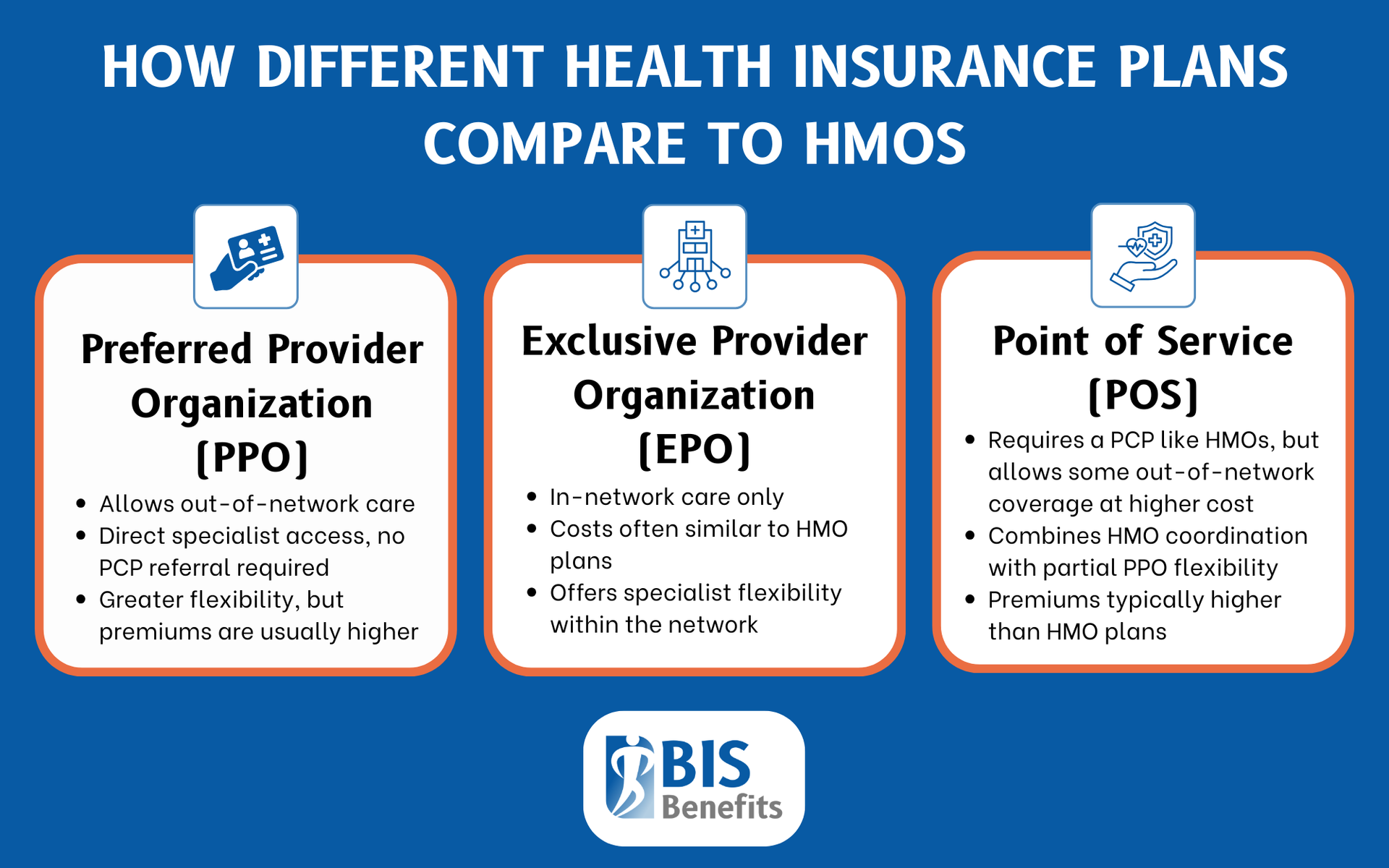
HMO vs. Other Health Insurance Plan Types
Preferred Provider Organization (PPO)
When comparing HMO plans to PPO plans, the key differences are that PPO plans allow out-of-network care at higher cost while HMO plans do not, PPO plans permit direct specialist access while HMO plans require referrals, HMO premiums are typically lower than PPO premiums, and PPO plans offer more flexibility while HMO plans offer more coordination.
Exclusive Provider Organization (EPO)
EPO plans share some similarities with HMOs in that both require in-network care only. However, EPO plans typically do not require a PCP or referrals, offering more specialist flexibility within the network. Costs are often similar between the two plan types.
Point of Service (POS)
POS plans allow some out-of-network coverage at higher cost and require PCP selection like HMOs, but offer more flexibility. POS premiums are typically higher than HMO premiums.
When choosing the right plan type, consider your healthcare needs and preferences, evaluate your budget for premiums and out-of-pocket costs, check which providers are in each plan's network, think about how often you need specialist care, and consider your comfort level with referral requirements.
Is an HMO Plan Right for You?
HMO plans may be a good fit if you:
- Want lower monthly premiums
- Prefer predictable healthcare costs
- Value coordinated care through one physician
- Live and work in the HMO's service area
- Rarely need specialist care
- Are comfortable with referral requirements
- Already have a preferred doctor in the network
HMO plans may not be ideal if you:
- Want flexibility to see any doctor
- Frequently need specialist care
- Travel often or live in multiple locations
- Have established relationships with out-of-network providers
- Prefer direct access to specialists
- Need coverage in areas where the network is limited
Before enrolling, ask important questions such as:
- Is my current doctor in the network?
- Are the hospitals I prefer in the network?
- What in-network specialists are available?
- How does the referral process work?
- What if I need care while traveling?
- What are the copays, deductibles, and out-of-pocket maximums?
Find the Right Health Insurance Plan for Your Business with BIS Benefits
A Health Maintenance Organization plan is a type of managed care health insurance that provides coverage through a network of providers, requires members to select a primary care physician, and uses referrals to coordinate specialist care. HMO plans offer lower premiums and predictable costs in exchange for less flexibility in provider choice and the requirement to stay within the network.
Evaluating your healthcare needs, budget, and provider preferences helps determine if an HMO insurance policy is the right fit for your business. If your company has at least 15 employees, BIS Benefits can help you consider your options and find the perfect match for your business.
Request a Quote today to get in touch with our expert insurance brokers.